The hospitals that never went digital may get there first
 Zohaib Akhtar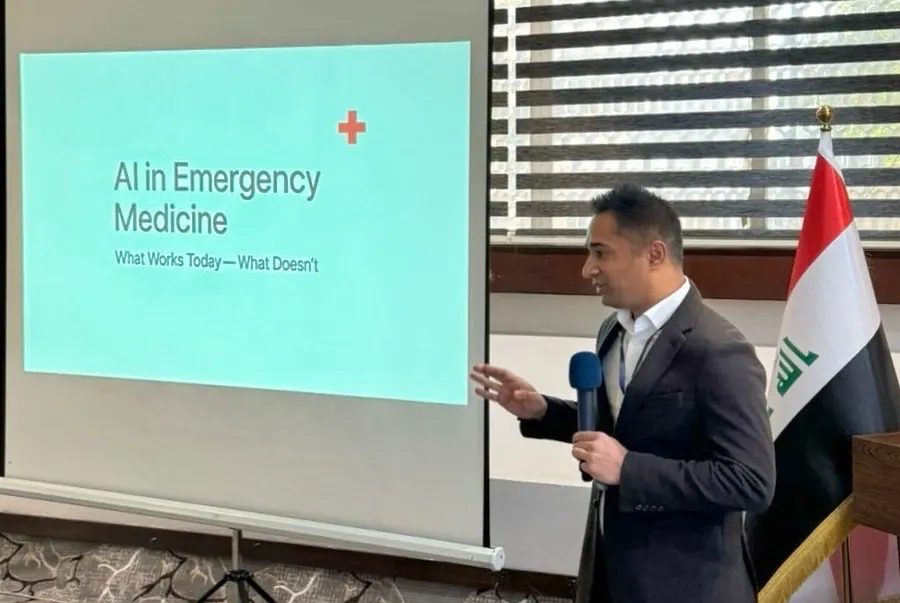
This is related to my visit to Baghdad in October 2025, at the invitation of the ICRC Iraq Delegation and the Iraqi Ministry of Health, to evaluate healthcare in the country.
What I remember most is the fear. Iraqi emergency departments are too disciplined for panic; this was something quieter and harder to watch. The attending physicians carried patient loads that would break most of their Western colleagues. They knew what good care looked like, and they knew they could not always deliver it. You could see the same knowledge in the patients, who had come to the emergency room the way people come to a last resort, hoping for care while half-expecting to go without it. The hospital did not feel like a place designed to make people well. It felt like an environment you might get sick in, and the ER was the last hope for a small miracle.
It took me days to understand that nobody in the room was failing. The clinicians were excellent. The patients were doing the only rational thing available to them. I was watching an unoptimized system, bleeding money for no reason, staffed by doctors whose growth was capped by their tools rather than their talent, treating patients deprived of care that already existed. Just not for them, in that room, on that day.
I spent a few days in Baghdad in October 2025, at the invitation of the ICRC's Iraq delegation and Iraq's Ministry of Health, assessing four of the city's major hospitals. The Ministry's question was practical: how do you digitize a national emergency system, affordably, without breaking it? I wrote a report. Reports get read by a handful of people and filed. That seems like the wrong fate for this one, less because my answers were right than because the problem belongs to far more people than the ones on the distribution list. So I'm putting it here, in public, where it can be argued with.
The paper card
The easy story about a paper-based health system is that it's behind. That story is wrong, and the way it's wrong matters.
An emergency department like Al-Yarmouk Teaching Hospital sees 500 to 800 patients a day. On a given shift, two to four senior physicians supervise roughly forty clinicians. The instrument holding this together is a single card, front and back: symptom checkboxes organized by organ system, a vital-signs grid, anatomical diagrams for marking wounds and burns, space for notes and orders. A physician completes it in about thirty seconds without taking their eyes off the patient.
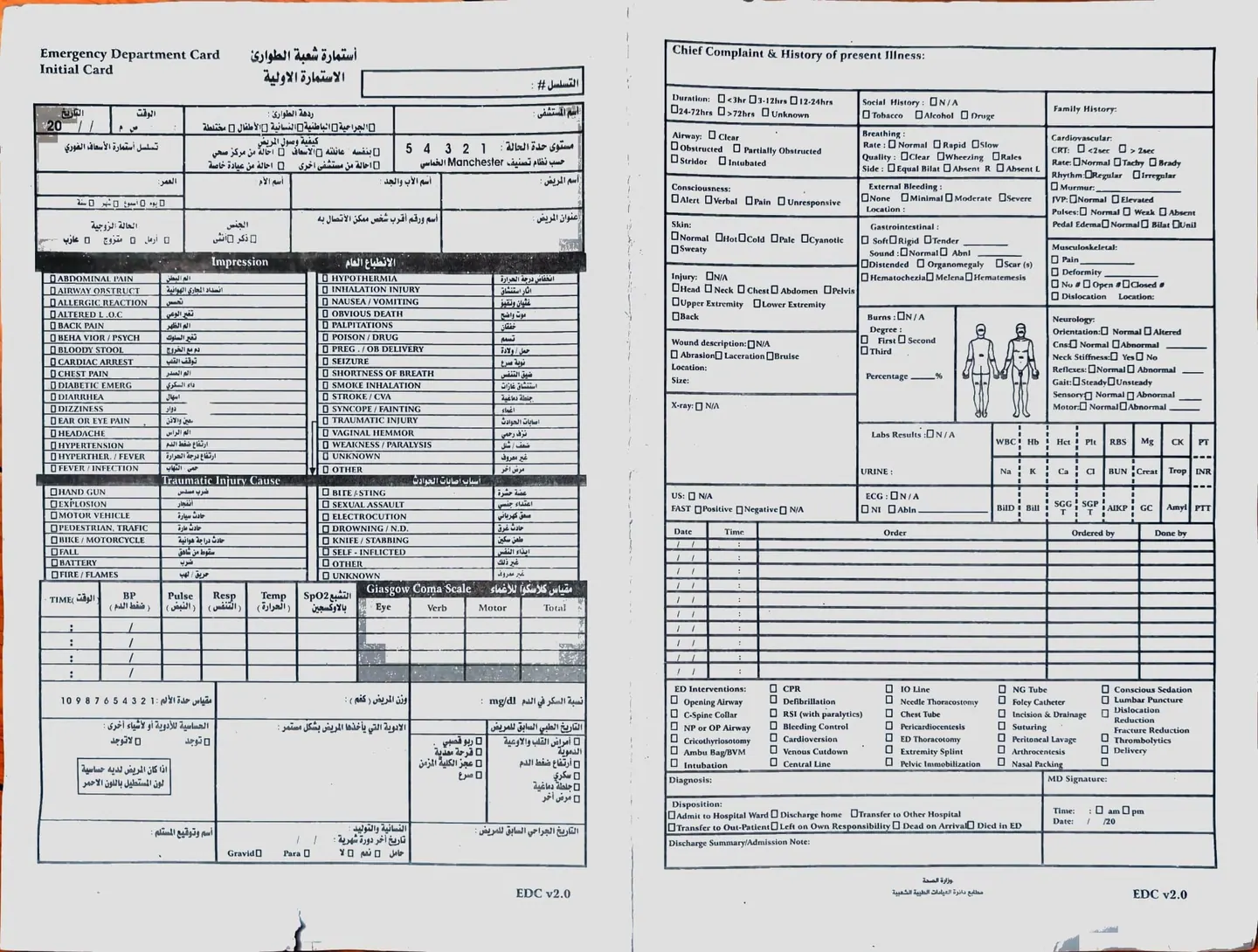
Iraqi Emergency Department Patient Card (Front)
Consider the country that digitized hardest. A 2016 time-motion study in the Annals of Internal Medicine found American physicians spending nearly two hours on electronic records and desk work for every hour of face-to-face patient care, then doing more of it at home after their shifts. Atul Gawande built an entire New Yorker essay, "Why Doctors Hate Their Computers," around what this has done to the profession. Documentation burden is now one of the best-documented drivers of American physician burnout. Baghdad's doctors carry many burdens. Typing is not among them. As an interface between a clinician and a patient, the Iraqi paper card beats most of the software I have used in wealthy hospitals. Then the visit ends and the card goes to a storage room.
What the losses add up to
I stood in those rooms. Thousands of records in boxes and on shelves, filed by name in theory, unretrievable in practice. Staff were frank with me: finding a specific file is not feasible. When it's attempted anyway it takes forty-five minutes or more, and it usually fails. So every returning patient is a new patient. Physicians at Al-Yarmouk and at Baghdad Medical City told me they routinely treat people with no knowledge of prior diagnoses, current medications, documented allergies, or previous results. If the patient can't supply the history, because they're confused or unconscious, the history does not exist. The bill for this is countable, and in my assessment I tried to count it.
A basic blood panel costs about $15. I estimated that a quarter to a third of laboratory tests in these departments are duplicates, repeats of work already done, ordered because the first result sits in a box no one can open. The laboratory runs on names alone, with no requisition numbers and no tracking. Results are handed to patients or their relatives to carry back through the hospital, and lab directors told me 10 to 15 percent never reach the ordering physician at all. The lab needs two to four hours to run a test. The physician often waits four to six to see it. The difference is not medicine; it is information loss, paid for in extended stays and delayed decisions.
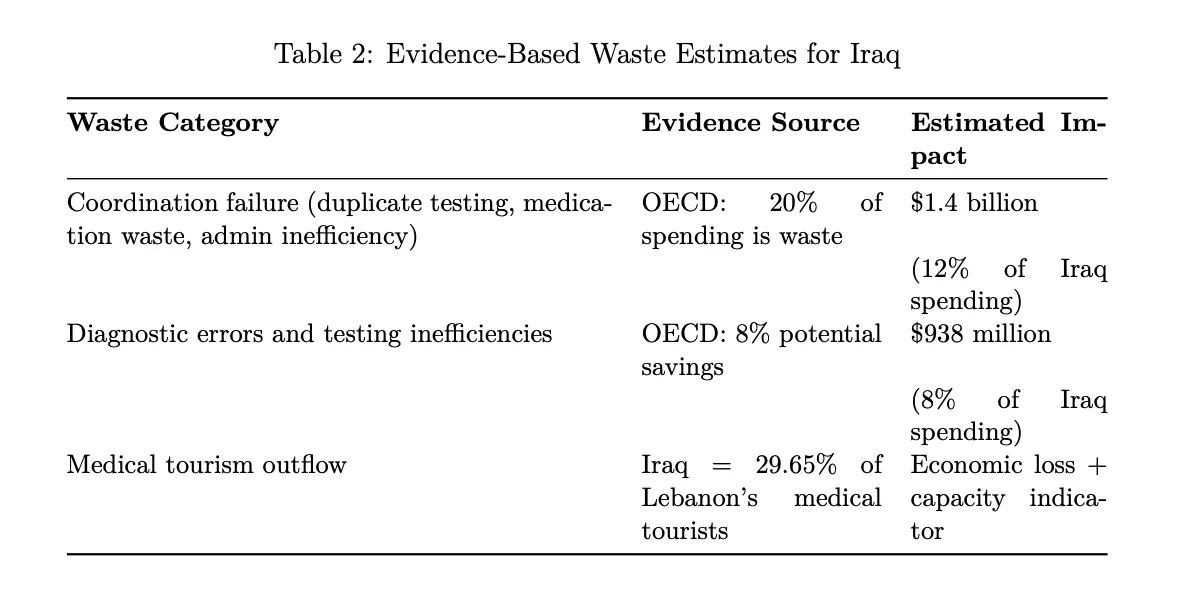
Pharmacies order from last year's guesses because nobody tracks consumption, so insulin runs out in one hospital while 15 to 20 percent of medications expire unused in another. Disease surveillance is compiled by hand at month's end and reaches the Ministry two or three weeks later. A diabetic who visits three hospitals is counted as three cases. A cholera outbreak surfaces as a vague rise in "diarrhea," weeks after containment was still possible.
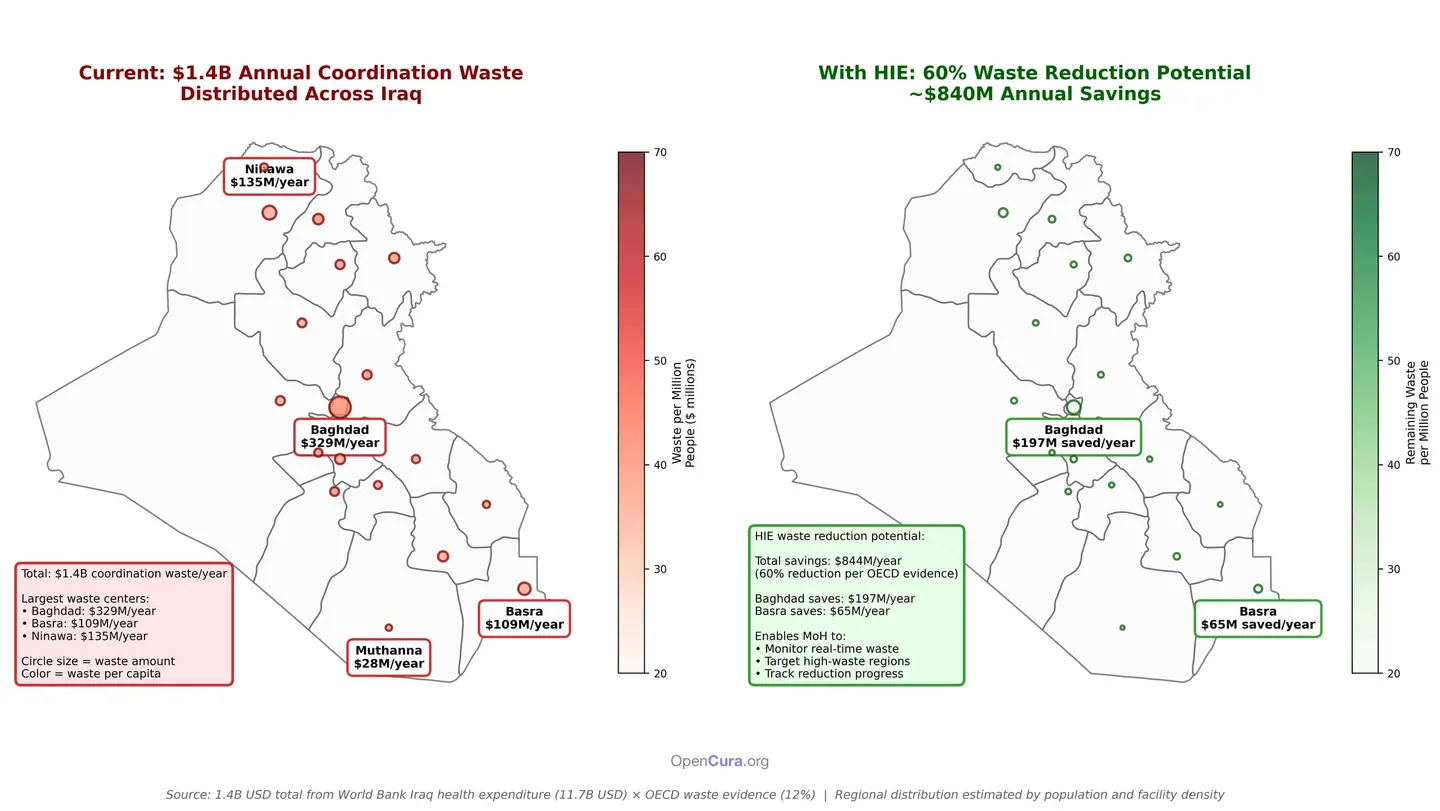
Across Iraq's 281 public hospitals, my estimate came to $900 million to $1.3 billion a year lost to coordination failure. Call it 11 to 15 percent of the country's health spending, consumed without buying any health.
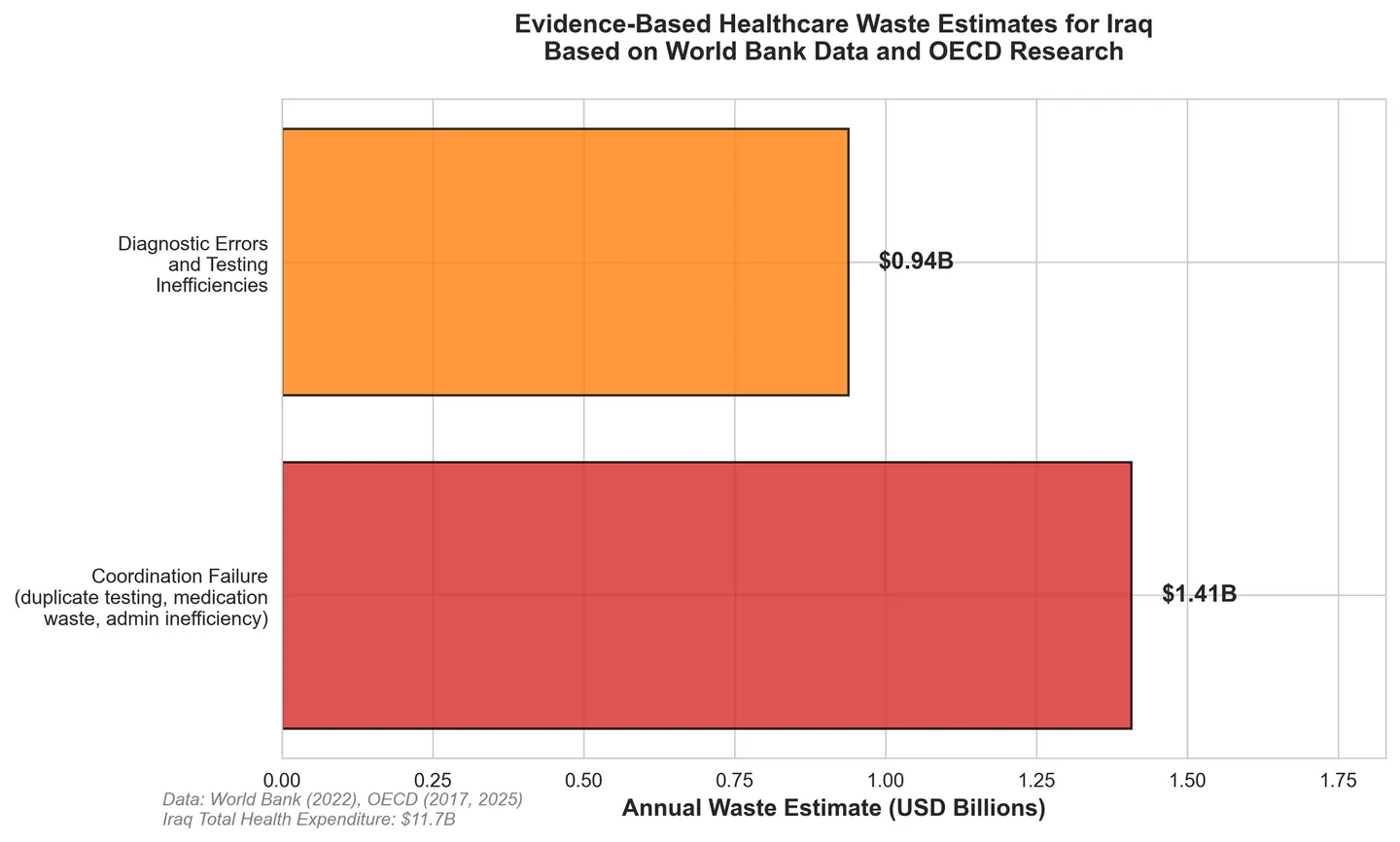
Annual Healthcare Waste Estimates Based on World Bank Data and OECD Research
It would be comfortable, reading this in Boston or London, to file it as a story about Iraq. The numbers say otherwise. Researchers writing in JAMA in 2019 put annual waste in American healthcare at $760 to $935 billion, a quarter of all US health spending, and they name failure of care coordination as one of its causes. The OECD estimates that about a fifth of health spending across wealthy countries buys nothing of value. It is the same disease at three orders of magnitude greater cost, with computers on every desk. Iraq's system forgets on paper. Most of the world's systems forget expensively, on screens.
Why the fix keeps failing
The reflexive prescription is to buy an EMR, install terminals, and train everyone. This has been tried, and it fails the same way almost everywhere.
Iraq attempted conventional EMR deployments three times between 2015 and 2022. All three were abandoned within six to eighteen months. The arithmetic never worked. You cannot ask a physician responsible for more than a hundred patients a shift to spend five to ten minutes per patient at a keyboard; productivity fell 30 to 50 percent whenever it was tried. Britain's National Programme for IT, the most ambitious civilian technology project ever attempted, was dismantled in 2011 after roughly £10 billion. The United States pushed adoption through with some $35 billion in HITECH Act incentives and won, in a sense. Its prize was the two-hours-of-typing statistic above and a burnout crisis it is still paying for.
Every one of these failures shares an autopsy: digitization fails when it treats the clinician's workflow as the thing to replace instead of the thing to protect.
That changes what Iraq's question even is. The Ministry does not face a choice between paper and digital. Paper wins at the bedside and loses at the level of the system; conventional digital inverts the trade. The real question is whether, in 2026, you can have both.
Regional Hospital Distribution and Monitoring Capability: Current system shows inequitable distribution with no real-time visibility (left). National HIE would enable Ministry of Health to monitor patient loads, resource utilization, and service gaps across all 18 governorates in real-time, supporting evidence-based resource allocation (right).
What mobile money proved
I think you can, and my reasons come from banking rather than from health IT. Twenty years ago Kenya was, by every conventional measure, decades behind the West financially. In 2006, a quarter of Kenyan adults had access to formal financial services. Then came M-Pesa: money moved by text message on basic phones, through corner-shop agents, skipping branches, cards, and the whole Western institutional stack. By 2021 financial inclusion in Kenya had reached 84 percent, and most of the country's GDP now moves through mobile money. India ran the same play with over a billion people. UPI, launched in 2016, now processes more than twenty billion transactions a month, nearly half of all real-time payments on Earth, while much of the West still waits days for a bank transfer to clear. Neither country caught up to the Western model. Both skipped it and landed somewhere the West hasn't reached.
Being behind turned out to be a form of freedom. Kenya had no branch-banking establishment positioned to defend itself. Iraq has no incumbent EMR industry, no billing-driven documentation culture, no fifty-year accretion of regulation around health records. And the technology that makes another path possible has only just arrived. The enterprise EMRs of the past two decades were built on one assumption: the only way to get information into a computer is to make a human type it. In the age of AI that assumption is obsolete, and so are the systems built on it. Modern models can read a photographed form, rushed handwriting and Arabic script included, and ambient AI tools already write clinical notes from conversation inside major American health systems. The typing, the thing that killed every previous attempt, is no longer required.
So the approach I proposed to the Ministry inverts the usual accounting. The current system is the expense; it loses more every year than a transformation would cost. Design the transition around minimal resistance rather than maximal technology. Keep the thirty-second paper card exactly as it is. Photograph it. Let AI extract the data in the background into a national registry, with one identifier linking a person's visits across every facility. The physician's day doesn't change. The system, for the first time, remembers.
There's a structural reason this could move faster in Iraq than almost anywhere else. The Ministry runs all 281 public hospitals directly, an architecture closer to Scandinavia's than to America's fragmented market. A model that works doesn't have to be re-sold to a thousand independent buyers; it can spread through the whole system by decision. And the same model travels, to Jordan, to Lebanon, to Yemen, to any country with strong clinical workflows and weak information infrastructure. Which is most countries.
What I don't know
The mobile-money story has a survivor bias, and health data is not payment data. I should say plainly what could sink this.
A transaction is simple and self-verifying. A clinical record is neither. AI extraction from handwritten cards will make errors, and a wrong allergy in a database can be worse than no database at all. Health records raise governance questions that mobile money never faced: who sees them, who secures them, what a breach means for a patient's safety in a conflict-affected state. Iraq's power grid is unreliable. Its hospitals are stretched. Global health is littered with pilots that worked beautifully in two hospitals and died quietly at twenty. And my cost figures rest partly on staff interviews and published literature rather than audited data; I flagged them as estimates in the report and I flag them the same way here.
The approach I've described is a hypothesis. It may need serious revision. It may be wrong. I did the work, which is why I'm writing about it, and that is a different thing from claiming to have solved it.
What I would defend without hedging is smaller and sturdier. The binding constraint on emergency care in Iraq, and in subtler forms nearly everywhere, is not clinical skill and mostly isn't money. It's the absence of memory, and that absence has a price you can count in duplicate tests and expired insulin. The lesson of every failed digitization is to protect the clinician's workflow. And for the first time, the technology exists to satisfy both of those truths at once. The countries with the least legacy have the most room to use it.
I keep thinking about the fear I saw in those attending physicians. It was not fear about their own ability. They could see, every shift, the doctors they might be inside a system that worked, the same way a patient in that room could see that the care existed somewhere, for someone else. Closing that gap is not mysterious. It is mostly a matter of letting a system remember what its own people already know. Somebody is going to demonstrate that leap in emergency medicine the way Kenya demonstrated it in money, and I would not bet against it happening in a place the world has written off as behind.
This essay draws on a field assessment I conducted in Baghdad in October 2025 with the support of the ICRC Iraq Delegation and the Iraqi Ministry of Health. External figures cited: Sinsky et al., Annals of Internal Medicine (2016); Shrank et al., JAMA (2019); OECD, Tackling Wasteful Spending on Health (2017); Gawande, The New Yorker (2018). Views and errors are mine alone.