Why Chroneme?
- Zohaib Akhtar

- Apr 6
- 2 min read
If you’ve lived this, in a hospital, in your own family, you know why this matters.
Medicine is a series of signals. But today, we only listen to them one at a time.
During college, I saw my father paralyzed after 19 days of signals the system simply didn’t connect. Recently, my mother’s aggressive cancer went undetected through a year of clinical visits.
There are so many layers to a person’s health. Genetics, environment, labs, vitals, medications, lifestyle, wearables,, family history. This is across every provider, and across years. No system reads them together. Every alert in medicine today checks one number against some threshold at one moment. Meanwhile, diseases develop slowly, across signals, across time, right in front of us.
Solving this has been multidisciplinary. Hopkins Medicine showed me how to think beyond the clinic. Bloomberg Public Health revealed where the system fails at scale. A year in Denmark taught me to design from the patient’s perspective. Kellogg pushed me to challenge and scale it. None of this without the mentors and colleagues who backed me without needing to know where it was going.
I’m lucky to have found Chenyu at Hopkins, who questions every assumption until it’s unbreakable. And bonded with Adam at Kellogg, who sees what I miss and knows how to make it hold.
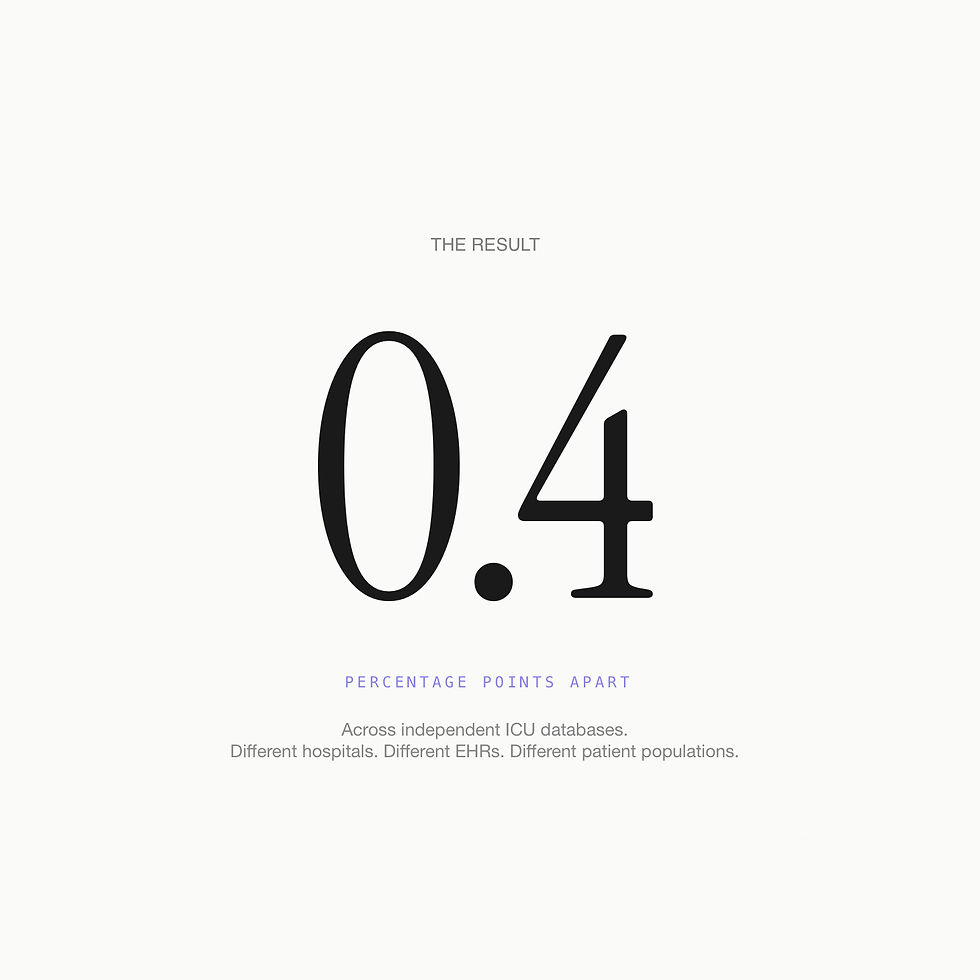
No blackbox, by design. Two years of R&D. We built a system that reads how these layers change together over time. Tested it in the hardest place in medicine. The ICU. Across 200+ hospitals, hundreds of thousands of stays. It caught deterioration hours to days before current systems flagged anything. An AUROC of 0.926, outperforming the best general purpose AI on the same data.
For the first time, the full picture is already there when a clinician opens the chart. And for the person living it, a clear understanding of what’s changing, why, and what to do next.
That’s Chroneme.